
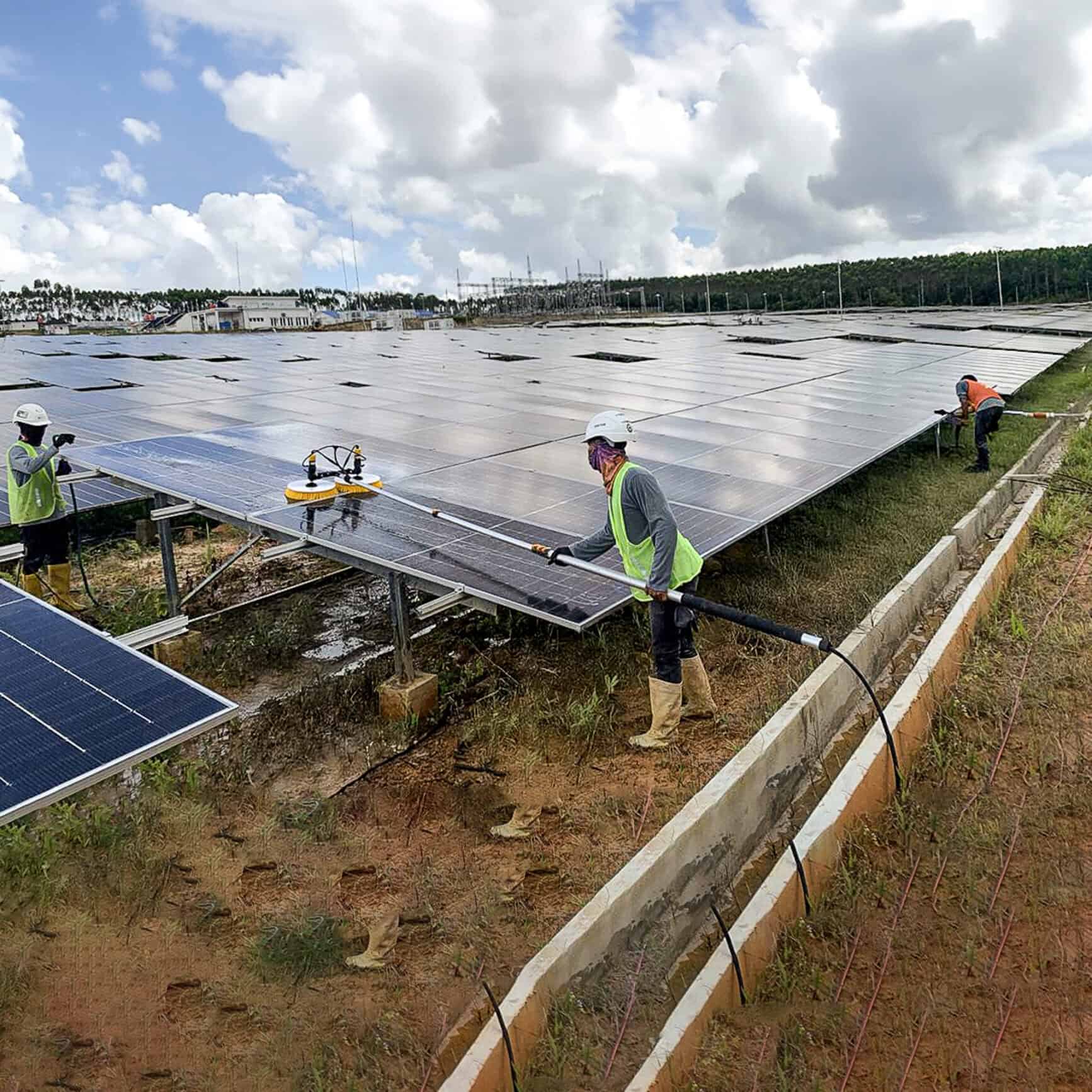
For most people in Germany, electricity is something they take for granted. A brief power outage is enough to become a topic of conversation. In Indonesia, the challenges are significantly greater: the island nation comprises more than 17,000 islands, many of them far from central power grids. For decades, diesel generators were therefore the main source of energy for numerous communities.
Today, this picture is changing. More and more islands are turning to photovoltaics, battery storage and intelligent control systems. For us at SAE, this very clearly demonstrates the role that intelligent automation can play in the energy transition. Generating renewable energy is only one part of the task. It is equally important to reliably coordinate generation, storage and consumption.
This is exactly what we are working on together with our long-standing Indonesian partner Syntek Energy & Control. And we are proud that the impact of this collaboration is not abstract, but can be seen in very tangible terms on islands such as Semau and Temajuk.
From Diesel Generators to Intelligent Microgrids
Supplying small island grids with diesel is complex and expensive. Fuel often has to be transported by ship, operating costs are high and dependence on international fuel prices remains. This is why Indonesia has been pursuing a systematic transition away from diesel for several years.
Existing diesel power plants are gradually being modernized and combined with photovoltaic and storage solutions. The goal is clear: a reliable power supply combined with lower emissions and operating costs.
But solar modules alone are not enough. Photovoltaic systems, battery storage and diesel generators must work together intelligently. This is where the Energy Management System (EMS) jointly developed by SAE and Syntek comes into play.
Together with Syntek: Intelligent Control for Hybrid and Off-Grid Applications
Syntek Energy & Control has been our sales partner in Indonesia since 2019. Since 2020, we have been jointly developing an Energy Management System specifically designed for hybrid and off-grid applications.
In doing so, we combine different areas of expertise: SAE contributes decades of experience in remote control and automation technology. Syntek complements this with extensive expertise in the planning, integration and implementation of photovoltaic and hybrid energy systems in Indonesia.
The jointly developed EMS performs a central role. It enables centralized monitoring and coordinates the operation of the connected generation and storage systems based on the defined energy management strategy. To do so, it sends commands and setpoints to the respective local controllers.
This turns individual components into a coordinated energy system.
“The projects in Indonesia impressively demonstrate that the energy transition and security of supply are not mutually exclusive. With intelligent automation, even remote island grids can be operated economically and reliably. This is precisely where the potential of modern energy management systems lies.” Daniel Wittmaack, Managing Director LACROIX SAE
When the Energy Transition Becomes Measurable: The Microgrid
We are particularly proud that the impact of this technology is visible in real-world projects.
The project on these island was developed as a pilot project to support Indonesia’s program to reduce dependence on diesel. Our EMS coordinates the operation of photovoltaic systems, battery storage and diesel generators there.
The result: Islands can be powered for several hours exclusively by renewable and stored energy without relying on diesel power generation.
For us, this project demonstrates very clearly how intelligent automation can contribute to the energy transition: generation, storage and consumption are coordinated in a way that enables renewable energy to be integrated into the existing power supply in practice.
Temajuk: From 12 to 24 Hours of Electricity Availability
The impact is even more immediate on the island of Temajuk.
By combining solar power, battery storage and an EMS, electricity availability was increased from 12 to 24 hours per day. For local residents, this means not only greater comfort, but also new economic opportunities.
Projects like these show us why intelligent energy and automation technology can play an important role in transforming power supply systems. Here, technological progress is reflected not only in installations and systems, but in a tangible improvement in electricity availability.
More Than Climate Protection: Reliable Power Supply for Remote Regions
The benefits of intelligent microgrids extend beyond reducing CO2 emissions. Communities become less dependent on fuel deliveries, operating costs decrease and security of supply increases.
At the same time, battery storage systems and intelligent control technologies enable stable grid operation, even with a high share of renewable energy.
Day-to-day operation also becomes simpler and more efficient. Automated energy management reduces the need to manually start or stop diesel generators when weather conditions change and photovoltaic power generation fluctuates as a result.
Technology with a Visible Impact on the Ground
Our joint projects with Syntek now include installations on Derawan, Nanga Meje and Temajuk.
For us at SAE, these projects are a concrete example of what becomes possible when renewable energy, storage technology and intelligent automation come together.
We are proud to contribute our experience in remote control and automation technology to this development. On Indonesia’s islands, the practical meaning of the energy transition is becoming visible: isolated island grids are being transformed into intelligent energy systems, turning an infrastructure challenge into a sustainable prospect for the future.